
When choosing a high-lift water pump for residential use, what matters is whether the pump can actually deliver enough water to the required height under real operating conditions.
This article introduces five types of water pumps used in household water supply, with examples drawn from manufacturer documentation.
“Top 5” is a selection list organized by application, not a brand ranking or a durability test result.
5 Things to Remember
- Choose a water pump based on the water source, head, and flow rate needed.
- Distinguish a tank-filling pump from a booster pump for shower fixtures.
- Do not combine maximum flow rate and maximum head into a single operating point.
- Check the correct voltage, frequency, and installation conditions for each model.
- Clean-water pumps and wastewater drainage pumps serve two different systems.
What Is a High-Lift Water Pump Used For
A high-lift water pump adds energy to move water from a lower source to a higher position. For example, from an underground tank to a rooftop tank.
“High-lift” describes the pump’s task, not one single design.
If the rooftop tank is full but the shower still runs weak, measure the pressure at the fixture, valve, and pipe. Switching to a more powerful tank-filling pump will not necessarily solve that problem.
For systems that supply water directly to fixtures, pump selection also depends on the pressure that must be maintained when several taps are open at once.
Automatic booster pumps or pressure-controlled pump sets must be evaluated against this specific task.
Top 5 Water Pump Types for Different Needs
The five pump types below are classified by design and operating principle, not tied to any specific brand. Before purchasing, confirm the specifications, pump curve, and availability of the actual model in Vietnam.
1. Peripheral Impeller Pump for Small Water Supply Needs
Peripheral impeller pumps, commonly called “peripheral” pumps, are a type worth considering when a household needs to move a moderate amount of water up to a high tank.
This is a clean-water pump line using a peripheral-type impeller, common in the small-capacity residential segment.
Consider this type when the main need is filling a tank, a longer pump run time is acceptable, and the installation location is convenient for maintenance.
Ask the seller to confirm the flow rate at your home’s actual head.
The key limitation to watch is water quality and suction conditions.
Do not use a clean-water-only model to draw water containing sand, debris, or abrasive sediment; also, do not assume every peripheral pump is self-priming.
2. Self-Priming Jet Pump for Low Tanks or Shallow Wells
A self-priming jet pump is worth investigating when the pump sits above ground and draws from a lower source.
This is a self-priming centrifugal (jet self-priming) pump line, typically offered for residential water-supply applications.
The advantage to weigh is the pump’s ability to handle air in the suction line, thanks to its design.
However, “self-priming” does not mean the pump can run dry or skip the initial priming step described in the user manual.
Before choosing, measure the suction lift, pipe tightness, and how much the water level changes while the pump is running.
If the water level drops beyond the model’s suction limit, simply increasing power is not the right fix.
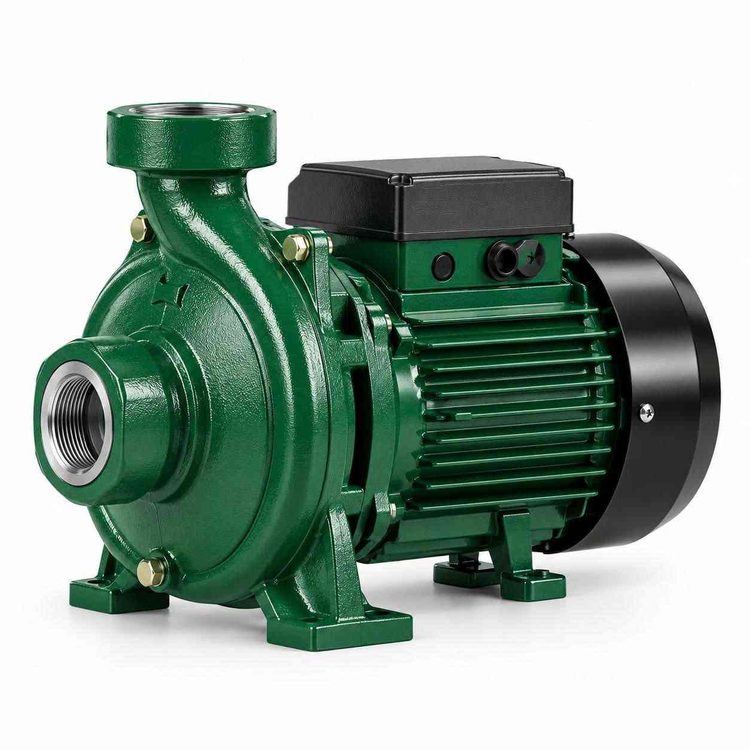
3. Single-Stage Centrifugal Pump for Moving Water Between Tanks
A single-stage centrifugal pump is an option to compare when a household wants to move water between tanks with a stable supply source.
This is a single-stage centrifugal pump line, commonly found in the residential clean-water pump catalogues of many manufacturers.
For the same tank-filling goal, compare the expected pump run time and the electricity used per fill.
A pump with a larger nominal flow rate is not necessarily faster at filling a tank if the actual piping shifts the operating point significantly.
This pump type needs clear confirmation regarding priming and suction-line layout.
If the water source sits lower than the pump, request that the lowest expected water level be provided to whoever is selecting the pump, rather than just the rooftop tank height.
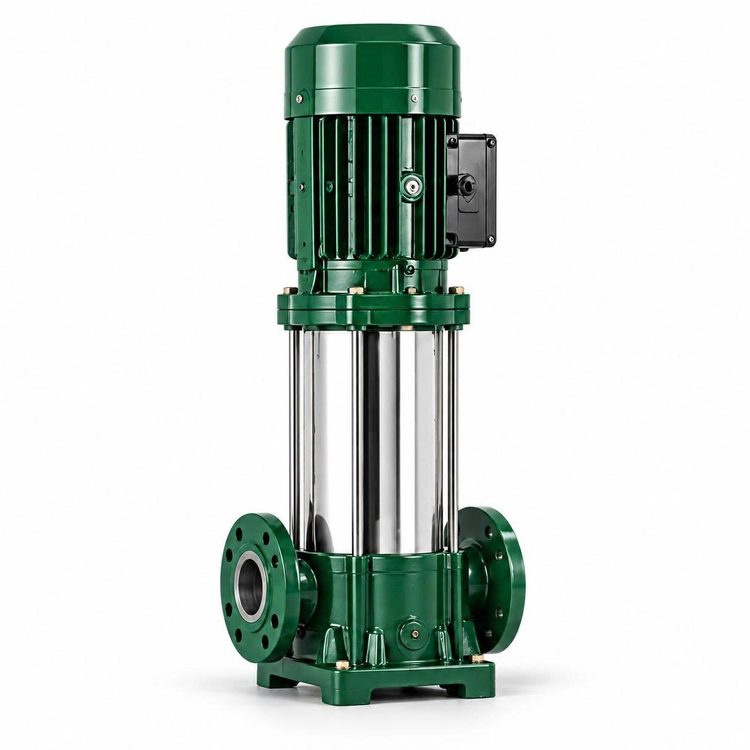
4. Multistage Centrifugal Pump for Higher Head Requirements
A multistage pump has several working stages in series, which builds head depending on the design configuration.
This is a multistage centrifugal pump line, typically offered for clean-water transfer and water-supply applications requiring higher pressure.
Consider this group when a single-stage option cannot deliver the required flow at the needed head.
The designer also needs to check the allowable pressure rating of the pipe, valves, and connected equipment.
A multistage pump is not the same thing as a variable-frequency (inverter) pump.
If automatic adjustment is needed as the number of open taps changes, confirm that the controller, sensors, and protection mode are compatible; do not assume automatic behavior just because a pump has multiple stages.
5. Submersible Borehole Well Pump for Drawing Water from Deep Sources
When the water source is too deep for a surface-mounted pump, a submersible borehole well pump is the type to evaluate. This is a submersible, column-shaped pump line (a slim body sized to fit the well bore) used to supply clean water from a well.
Because the pump sits underwater, factors to consider include well diameter, dynamic water level, installation depth, and cooling conditions.
The dynamic water level is the water level while the well is being drawn down, which can be lower than the level before the pump starts.
Also plan for how the pump will be pulled up for maintenance, the cable length, and dry-run protection.
A submersible borehole pump is different from a submersible sump drainage pump; both being placed underwater does not mean the two devices are interchangeable.
Comparing Pump Types Before You Choose
| Pump Type | Need to Consider | Point to Confirm |
| Peripheral impeller | Filling a tank at a moderate flow rate | Flow rate at the actual head |
| Self-priming jet | Drawing from a low tank or shallow well | Suction limit and pipe tightness |
| Single-stage centrifugal | Moving water between tanks | Supply source and priming conditions |
| Multistage centrifugal | Needing higher head | System pressure and controls |
| Submersible borehole | Drawing from a deep source | Dynamic water level and well size |
This is an initial screening table. Several types may be able to handle the same job; the final decision should be based on the performance curve of the specific pump model.
How to Choose a Water Pump by Head and Flow Rate
Start With the Volume of Water You Need to Move
Illustrative calculation: to add 1,000 liters of water to a tank within 40 minutes, the average flow rate needed is 25 liters/minute.
This is the requirement under actual operating conditions, not the maximum flow figure quoted in marketing material.
If the household continues to draw water while the tank is filling, add that simultaneous usage to the calculation.
For direct water supply, list the fixtures that could run at the same time and the pressure each one requires.
Calculate Head From the Source to the Delivery Point
According to the Hydraulic Institute’s guide to system curves, system head is made up of components related to elevation, pressure, and losses as water moves through the system.
So, the number of floors in a house is only a starting point.
For two open tanks, you can roughly estimate the required head as the difference in water-surface elevation plus pipe and fitting losses.
Use the lowest expected source water level and the least favorable receiving conditions to assess whether a pump can fill the tank.
Assuming the elevation difference is 18 m and the calculated loss at 25 liters/minute is 5 m, the required operating point is 25 liters/minute at 23 m of head.
These figures are only illustrative of the calculation method, not a standard for every three-story home.
Reading a Model’s Performance Curve Correctly
On the pump curve, find the required flow rate, then read off the corresponding head. Ask the supplier to clearly indicate the operating point and the allowable operating range.
Illustrative example: the curve for a peripheral pump model shows 19.5 m at 25 liters/minute when the source water level is level with the suction inlet (HS = 0 m).
That point does not meet the 23 m requirement assumed above, even though the maximum head is listed as 40 m.
Do not interpret “maximum head of 40 m” as meaning the pump still delivers its maximum flow rate at 40 m.
Also, do not mechanically add the maximum suction lift and maximum discharge head unless the manufacturer’s documentation explicitly defines them that way.
Installation and Operating Cost of a Water Pump
Confirm the Pump Location and Piping
Send your installer a diagram of the water source, pump location, tank elevation, pipe length and diameter, and the number of elbows and valves.
Include a photo of the electrical rating label from the power supply, or confirmed electrical specifications to avoid selecting the wrong version.
Request a quote covering the pump, controller, accessories, wiring, and installation labor.
For automatic tank-filling systems, clarify how the system stops when the tank is full and how it protects the pump when the source runs dry.
Calculate Power Consumption and Run Time
According to the U.S. Department of Energy (2006), evaluating a pump should account for the whole system and its operating cost.
You cannot conclude that a pump with a lower wattage rating is always more economical for moving the same amount of water.
As a hypothetical example, a pump with an average electrical input of 0.4 kW, running one hour per day for 30 days, would use approximately 12 kWh.
The corresponding cost equals 12 kWh multiplied by the applicable electricity rate; do not substitute mechanical output power for electrical input power.
Test-Run Before Handover
At acceptance, request checks of the on/off cycle, water leaks, and tank-filling capability.
Wiring, grounding, and leakage-protection equipment should be installed by a qualified professional, following the model’s instructions and site conditions.
Questions to Ask When Buying a Water Pump
Motor and Power Supply
Compare the voltage, frequency, and phase count on the motor label with the actual power supply. Do not select a pump based on suitable capacity alone and only address the power supply afterward.
Stainless Steel Materials and Usage Conditions
Many multistage centrifugal pump models use AISI 304 or 316 stainless steel for the body and impeller, depending on the product line. Stainless steel material still needs to be checked against water quality and each model’s specific limits.
Warranty and Replacement Parts
Ask the seller to clearly state the warranty period, where repairs are handled, and the availability of replacement parts.
Also ask about delivery time so you can plan the installation schedule and avoid interrupting your household water supply.
When to Talk to Zoeller
If your project’s actual need is basement dewatering, or lifting wastewater from a basement bathroom up to the main drainage line, shift your focus to a dedicated drainage system instead.
Do not choose a clean-water supply pump for this task.
In the Zoeller Vietnam introduction document (2025), the company presents sump pumps, sewage pumps, and the Qwik Jon Upflush system.
This is the right scope to start the conversation when a project cannot drain by gravity.
Send a description of your needs and a site diagram to a Zoeller Vietnam representative to request confirmation of the right solution. State clearly whether you need clean water supply or wastewater drainage, along with elevation, piping, and flow rate, so the conversation starts in the right direction.
Frequently Asked Questions
1. How Many Watts Should a Three- or Four-Story House Choose?
There is no fixed wattage level based on the number of floors.
You need to determine the elevation difference, pipe losses, and desired flow rate, then choose a model that meets that operating point; power rating is the parameter to check next.
2. How Much Does It Cost to Buy and Install a Tank-Filling Water Pump?
Cost depends on the pump type, controller, piping run, and existing electrical work.
Get quotes covering the same scope of work, and require that the pump, accessories, installation labor, and warranty terms are clearly stated, so you can compare accurately.
3. Does a High-Lift Pump Automatically Shut Off When the Tank Is Full?
Only if the system has a suitable water-level controller or automatic mechanism that has been correctly wired.
Confirm separately the function that stops the pump when the tank is full and the protection that activates when the source runs dry; motor overheat protection does not replace either of these two functions.
Also read: How to Install Submersible Wastewater Pump: Step-by-Step Guide




 English
  简体中文
简体中文  Tiếng Việt
  繁體中文
繁體中文  한국어
한국어